

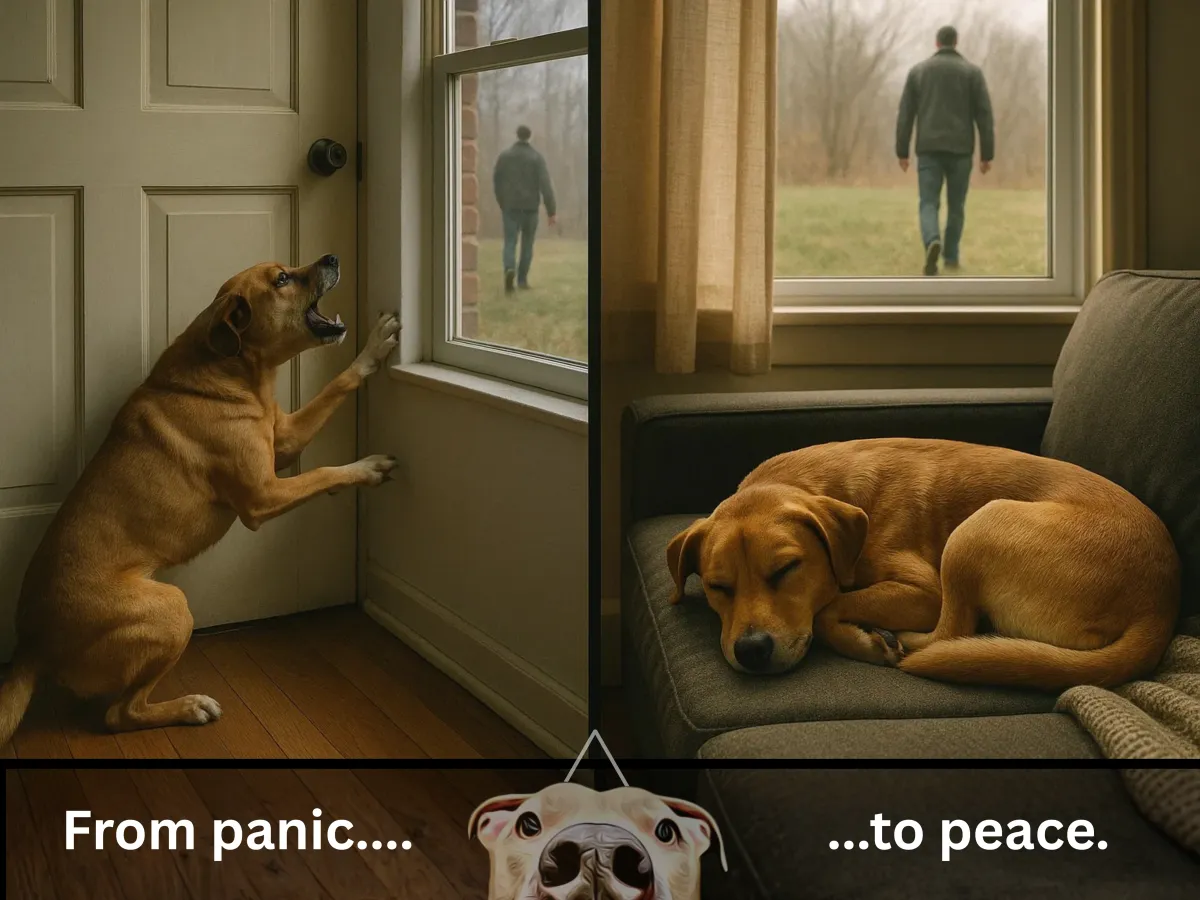
Does your dog panic
when you step out the door?

Barking / Crying?
Destruction?

Pacing & Restless?

Urination / Defecation?

Neighbor complaints?
THERE IS HOPE.
We can help them feel safe again - and help you get your life back.
You’ve rearranged your schedule. You avoid going out. You come home to tears, destruction, or heartbreak. You love your dog — but nothing seems to help.
That’s because separation anxiety is a genuine phobia of being alone, and everyday training techniques simply aren’t designed to treat true panic disorders. For these dogs, the experience can feel as intense as a human panic attack. When fear takes over, their behavior isn’t about anger, spite, or stubbornness — it’s a desperate attempt to find relief.
Millions of dogs struggle with this kind of anxiety, and without help, it often worsens over time. The good news? It’s treatable.
Book your free 30-min discovery call!
Why Work With a Certified Separation Anxiety Trainer?
While many excellent trainers can help with a wide range of behaviors, a Certified Separation Anxiety Trainer (CSAT) is uniquely trained in protocols specifically developed for treating separation anxiety — a fear-based condition that requires a highly specialized approach. CSATs complete over 100 hours of advanced education and mentorship focused solely on separation anxiety treatment, along with rigorous testing to ensure the highest professional standards.
Think of it this way: your family doctor can handle most things, but when you need more specialized care, they refer you to a specialist — like a cardiologist or neurologist. It’s the same in the dog training world. CSATs are the specialists for separation anxiety — trained to address this unique form of fear using methods grounded in behavioral science, emotional regulation, and gradual desensitization.
How Training Works
Because separation anxiety is a panic disorder, training must move at your dog’s pace. For this reason, we begin with a one-month minimum commitment. Here’s how to get started:

Step 1:
Free Discovery Call
Find out if this is right for
you and your dog
Complete a quick form and book your FREE 30-minute phone consult. We'll discuss your case and I'll answer questions about separation anxiety training.
Step 2:
Initial Assessment
90-min virtual consult and full behavior assessment
We’ll dive deeper into your dog’s history and alone time goals, go over the training workbook, and wrap up with a guided alone-time assessment.
Step 3:
Book your package!
Individualized daily training plans and weekly reassessments begin
A tailored training plan will be designed specifically for your dog. This includes 4 training sessions a week and 1 weekly live video reassessment.
PRICING
STEP 1:
Initial Assessment
$225
No obligation session to see what's really going on
The initial assessment must be booked first. During this session, we will:
Review training protocol in more detail
Review our shared workbook
Conduct assessment to observe your dog's current comfort with alone time
Review your home layout
Discuss technological needs
Identify departure routines
Identify pre- and post-departure cues
Discuss and brainstorm absence management
STEP 2
Pick Your Program
Program A:
Weekly Intensive
$700
4 Live Sessions Per Month
Program B:
Bi-Weekly Support
$350
2 Live Sessions Per Month
Both programs include 4 days of missions per week, training plan adjustments, email/text support, and ongoing guidance between sessions.
ALUMNI ONLY
Support Session
$175
This single session offers individualized support for wherever you are in your separation anxiety journey. We can use the time to:
Review your training data
Assess your dog’s current progress
Troubleshoot plateaus or regressions
Review video recordings
Conduct a live assessment
Discuss and brainstorm absence management
Anything else you need!
Frequently Asked Questions (FAQ's)
How do I know if my dog has separation anxiety?
Common signs include excessive vocalizations (barking, howling, whining, crying), pacing, panting, drooling, destructive behavior near doors or windows, and accidents when left alone. Some dogs even injure themselves trying to escape. A professional assessment helps confirm whether the behavior is true separation anxiety or something else (like boredom or noise sensitivity).
Can separation anxiety really be fixed?
Yes — it’s treatable with the right approach. Recovery takes patience and consistency, but dogs can learn to feel calm and relaxed when alone. Progress happens gradually, and success depends on going at your dog’s pace, using a structured, customized training plan tailored to your dog's current comfort level with alone time.
Why can’t I just try crate training or leave my dog for short periods?
Most DIY or “quick fix” methods risk pushing dogs too far, too fast — which can actually make the fear worse. Successful treatment depends on identifying your dog’s exact comfort threshold and building on it gradually, never letting them panic. This is the heart of what CSATs are trained to do.
How long does it take to see results?
Every dog is different. Some guardians start noticing small improvements in a few weeks, while others take several months to reach full comfort. The pace depends on factors like your dog’s history, sensitivity, and how consistently the plan is followed — but with steady work, progress happens.
What does the training process look like?
You’ll start with a live video assessment, then receive a customized plan with four training missions per week — each one designed specifically for your dog by your CSAT. Every mission gently builds your dog’s confidence while keeping them below their panic threshold.
We use a process called gradual desensitization — a science-based method that helps dogs feel safe when alone by introducing short, manageable absences and slowly increasing duration as they’re ready. You’ll receive daily support, weekly reassessments, and detailed progress tracking to monitor growth and keep you moving forward.
Can I leave my dog alone while we’re doing the program?
During our treatment protocol, we avoid leaving your dog alone outside of our training sessions— since that can set back progress. Together, we’ll create a realistic management plan to suspend absences (like using sitters, walkers, daycare, or adjusted schedules) so your dog’s training can move forward smoothly.
Do I need to live nearby to work with you?
No — separation anxiety training is done entirely online! This allows me to observe your dog’s true alone-time behavior without my presence influencing them. All you need is a device with a camera and audio, and I’ll guide you through setup before we begin!
My dog was fine before. Why did this suddenly start?
Separation anxiety can surface after major life changes — a move, a new routine, a shift in the household, or even a stressful event. Sometimes there’s no obvious cause at all. What matters most is how we move forward to rebuild your dog’s sense of safety.
What’s important to remember is that separation anxiety is no one’s fault - it is a genuine phobia, not the result of anything you or your dog did wrong. With the right approach, it’s completely treatable.
Will medication help?
In some cases, medication prescribed by a veterinarian or veterinary behaviorist can support the training process by reducing panic and improving learning. If you’d like to explore this option, I can help you start that conversation with your veterinary team or make a referral to a trusted veterinary behaviorist in my network. With your consent, I’ll gladly collaborate with your veterinary team and share progress data so we can work together for the best results.
Book your free 30-min discovery call!

Custom Request? Ready to start?
Let us know how we can help!

DISCLAIMER: Behavior modification is a collaborative process that depends on the consistent implementation of training techniques by the owner. While we specialize in fostering positive behavioral changes, no trainer can guarantee specific outcomes or "cure" a dog's behavior. As behavior is influenced by numerous factors, including environment and individual circumstances, the dog's behavior remains the responsibility of the owner.