Why Your Dog Responds at Home and Struggles Outside
Why Your Dog Responds at Home and Struggles Outside
By: Leah Bornstein (CDBC, CSAT, FFCP, VSA-CDT)
At home, your dog responds to familiar cues. Outside, you start wondering whether you brought the same dog. You’ve practiced. You’ve rewarded them. You’ve seen them do it.
So it’s understandable to think, “Why is my beloved dog being so incredibly stubborn?!”
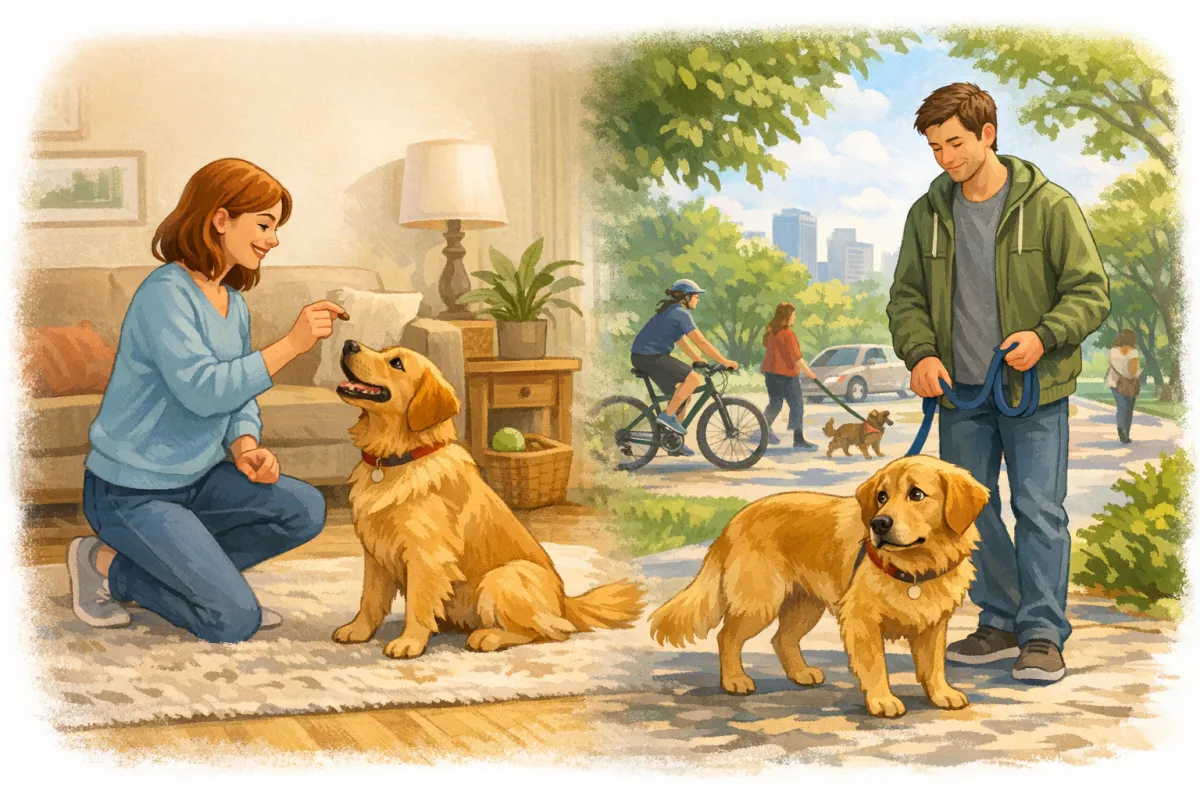
And there may be more happening. The setting, nearby activity, and your dog’s emotional state can affect how easily they respond. Skills need practice around gradually increasing distractions.
Before deciding the training has mysteriously expired at the front door, let’s look at what changed.
Knowing a cue is the beginning. Fluency takes practice.
A cue is a signal you’ve taught your dog, such as a word or hand signal. Fluency means the skill becomes familiar and reliable through practice.
Your dog may have learned what the cue means in the comfort of home and still need help responding under different conditions. Three important parts of building fluency are distance, duration, and distraction:
Distance: How far away are you when you give the cue, or how far do you move away while your dog continues the behavior?
Duration: How long are you asking them to hold the behavior?
Distraction: What else is happening around them?
Increasing any of these can make the task harder. A brief response with you nearby is a different request from holding that behavior while you move away and another dog passes. That’s several difficulty settings turned up at once.
I recommend building one part at a time. When you add a distraction, keep the duration short and stay close. When you practice more distance, choose a familiar setting with fewer distractions.
Practicing in different places also helps your dog use the skill beyond where they first learned it. This is called generalization. Reinforcement supports that learning.
Instead of telling ourselves, “They know it,” consider:
Which parts have we practiced successfully?
Did I increase distance, duration, or distraction?
Did I make several things harder at once?
What can I make easier?
Your work at home still matters. It gives you a foundation to build on!
Outside has a lot going on
Other dogs, people, movement, and opportunities to explore can compete for your dog’s attention. Fear, frustration, or excitement may also make responding difficult. The behavior alone doesn’t tell us which explanation applies.
“Outside” also isn’t one consistent level of difficulty. The location may be familiar while what’s happening there changes.
Before asking again, notice what your dog is doing and what’s nearby. Are you working on a skill, or has the situation become more than they can comfortably manage?
If things are getting difficult, I’d prioritize creating space. Depending on what’s safe, that could mean changing direction or moving behind a visual barrier. These are management options that can help.
You don’t have to turn every encounter into a training exercise. The walk doesn’t need a pop quiz at every corner.
Make practice easier, then build from there
Start with one familiar skill in a safe setting where you can keep distractions manageable. Build toward busier environments gradually.
Here’s how I’d approach it:
Choose one small goal. Ask for a brief, familiar response. “Pay attention to me for this entire walk” is a much bigger assignment.
Keep the other parts easy. If distractions increase, shorten the duration and reduce your distance from your dog.
Use the familiar cue. If the response doesn’t happen, pause and review the setup before repeating yourself. You deserve a walk that involves more than saying the same word.
Reward the response. Use something your dog enjoys and that’s appropriate for them.
Adjust based on what you see. A quieter location, a shorter request, or more space from nearby activity may help.
Notice that there are two different distances to consider: your distance from your dog and your dog’s distance from a distraction. Staying closer to your dog while moving farther from a difficult distraction can make the task easier.
The aim is to create an opportunity to practice successfully, then build gradually.
What if treats aren’t helping?
Food can be useful, and appropriate activities can also serve as rewards. Your dog’s preferences matter.
And the reward is only one part of the setup.
If your dog won’t take food, I’d look at the whole situation before reaching for something more tempting. What are they doing? What’s nearby? Does the task need to become easier?
The answer may involve changing the setup, not continuing to upgrade the snack menu.
Taking food is useful information when assessing how a dog is managing distractions. I wouldn’t use it alone to decide how they feel or whether to increase difficulty.
Physical comfort matters, too
If a familiar movement suddenly becomes difficult, or your dog’s movement or posture changes, speak with your veterinarian.
Changes in everyday behavior can help identify possible pain, alongside a veterinary assessment.
You don’t need to know the cause before raising a concern. I’d pause a request that appears uncomfortable rather than keep asking.
Look for progress you can actually use
Keep notes simple: where you practiced, what was nearby, and how your dog responded. Include any changes to distance or duration.
A few useful details will do. You don’t need to write a dissertation after walking the dog.
Those details help you compare similar situations and choose the next step. A brief response in a manageable setting is something to build on. Recognizing when your dog needs an easier task matters, too.
Progress over perfection.
When personalized help would be useful
If walks feel unsafe, you’re worried about biting or escaping, or you’re unsure where to begin, general training tips may not be enough.
At Born to Be Dog Training, I help guardians understand their dogs and develop humane, practical skills for everyday life. In-home services are available in Morris, Sussex, and Essex Counties, New Jersey, with virtual options throughout the United States.
If you’d like help choosing an appropriate next step, schedule a complimentary Zoom discovery call. We’ll discuss what’s happening and which service may fit your needs.
Sources and Further Reading
Battersea: Attention around distractions, updated June 2026.
This article provides general education, not an individualized behavior plan or veterinary advice.