Why Was My Reactive Dog Fine Yesterday?
By: Leah Bornstein (CDBC, CSAT, FFCP, VSA-CDT)
Yesterday, your dog saw another dog across the street. They looked. Maybe they took a treat. Maybe they even looked back at you and kept walking.
You thought, YES. We are getting somewhere.
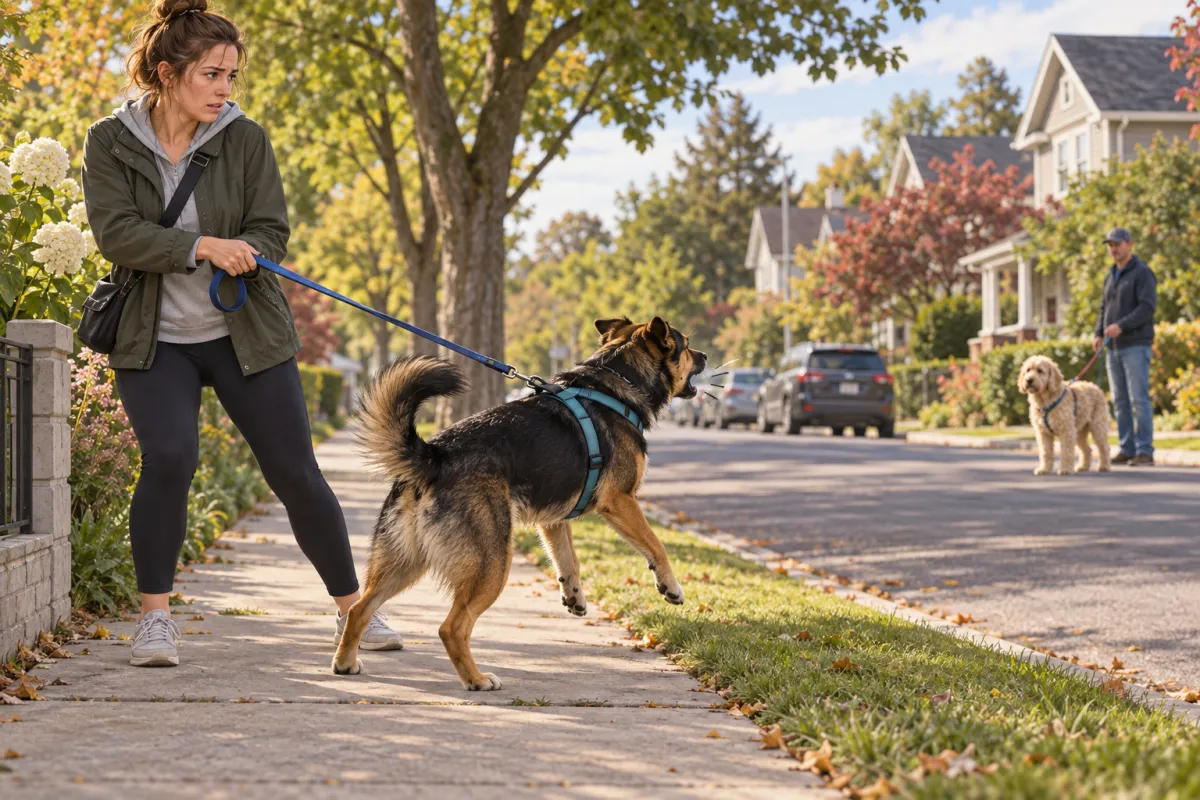
Today? Same street. Similar distance. Another dog appears—and yours is barking, lunging, or trying desperately to get away. What happened?!
It’s easy to look at a day like this and think your dog has regressed. Or that yesterday was a fluke. Or that you somehow did something wrong. But there’s something important I want guardians of reactive dogs to know: Your dog’s threshold is not a fixed number.
Threshold Is More Than Distance
In behavior work, we often talk about a dog being “under threshold” or “over threshold.”
Threshold is essentially the point at which a dog can no longer comfortably cope with what’s happening around them. It's like having an invisible bubble around you protecting your comfort zone; when someone pops that bubble, you react. Sometimes even panic - your sense of safety is gone!
Once arousal becomes high enough, learning and thoughtful responding become harder. Veterinary behavior guidance specifically notes that highly aroused dogs tend to respond more reflexively and may have difficulty learning. (Source: Merck Veterinary Manual — Behavior Problems of Dogs)
We often use distance to help.
Maybe your dog can comfortably watch another dog from 50 feet away but struggles at 35 feet. This is useful information! But that does NOT mean your dog’s threshold is permanently located somewhere around the 50-foot mark like an invisible property line that never budges.
Remember that the other dog isn’t the only thing your dog is experiencing at that time.
Your Dog Brings Their Whole Day With Them
Think about your own tolerance.
Let's say you burned your toast on a peaceful Saturday morning - maybe you sigh, but it's no biggie. The inconvenience doesn't ruin your day. You toss out the burned food and make yourself another batch. Then you move on. Minor inconvenience.
Now let's say that same incident happened after you slept badly, stubbed your toe getting up, received a stressful email from work demanding you rush in on your day off, and developed a headache. Suddenly, that burnt piece of toast is just the tip of the iceburg.
Context matters. And your dogs also responds to the larger context around an event.
Maybe your dog heard construction all morning. Maybe a loose dog rushed them yesterday. Maybe they had a stressful veterinary appointment. Maybe the dog approaching today is staring directly at them instead of sniffing the grass. Maybe your dog also didn't sleep well.
Weather, noise, proximity, movement, previous experiences, physical discomfort, predictability, and what else has happened that day can all potentially affect how difficult a situation feels.
Research has also found individual variation in dogs’ physiological responses to and recovery from stress, which is one reason I’m cautious about treating “recovery” as something every dog should do on the same timeline. (Source: Physiological Stress Reactivity and Recovery Related to Behavioral Traits in Dogs)
In other words: same dog + same distance does not necessarily equal the same experience.
“But Shouldn’t They Get Used to It?”
Not necessarily. Repeated exposure to something does not guarantee that a dog will become less bothered by it.
Habituation means a response decreases after repeated exposure to something.
Sensitization is essentially the opposite: the response becomes stronger the more you're exposed.
The quality of the experience matters more than the quantity or frequency. The American Veterinary Society of Animal Behavior (AVSAB) notes that intense or frightening experiences are more likely to produce sensitization rather than habituation. (Source: AVSAB — Getting Used to Things (or Not): Habituation vs. Sensitization)
That’s why I don't want to keep marching a struggling dog past other dogs hoping repetition will eventually make them stop reacting. More exposure isn't automatically better exposure.
So, What Do You Do on a Harder Day?
First: believe the dog in front of you today.
If yesterday your dog could work at 30 feet and today they need 60 feet, give them 60.
Cross the street. Duck behind a parked car. Turn around. Choose the quieter route. Skip the training opportunity altogether if your dog is having a hard time. That isn't failure.
Management is an important part of fear and reactivity work because it can help prevent overwhelming experiences while behavior modification is happening. (Source: AVSAB — Staying Safe: Management for Fearful Dogs)
And if your dog suddenly cannot take a treat when they normally can? Pay attention to that too. Food refusal isn't proof of one specific emotional state, but a change in your dog's ability to eat, sniff, disengage, or respond to familiar cues can be useful information about how they're coping (or not coping!).
If you see an abrupt or significant behavior change—especially alongside changes in movement, appetite, sleep, touch sensitivity, or general behavior—consider talking with your veterinarian. Pain and other medical conditions can also contribute to behavior changes. (Source: Merck Veterinary Manual — Behavior Problems of Dogs)
Progress Is a Pattern, Not a Straight Line
One hard walk does not erase three good ones.
Instead of asking, “Why couldn't my dog do what they did yesterday?” try asking: “What is different about what my dog is experiencing today?”
That question gives us somewhere useful to go. Maybe we need more distance. Maybe we need an easier environment. Maybe today needs to be a decompression day instead of a training day.
And sometimes, we need help figuring out which one.
If walks have become stressful for you and your dog, or reactivity is limiting your everyday life, you can schedule a free discovery call with Born to Be Dog Training. We can talk about what you're seeing and whether individualized behavior support would be helpful.
Your dog doesn't need to perform yesterday's version of themselves every day. We can meet the dog who showed up today and go at their pace.
This article provides general educational information and is not a substitute for veterinary diagnosis, treatment, or an individualized behavior assessment. Sudden or significant behavior changes, suspected pain, or other health concerns should be discussed with your veterinarian.
Sources and Further Reading
Merck Veterinary Manual — Behavior Problems of Dogs — peer-reviewed veterinary guidance on fear, anxiety, arousal, medical contributors, management, and behavior modification; full review September 2025.
American Veterinary Society of Animal Behavior — Staying Safe: Management for Fearful Dogs — discussion of management alongside desensitization and counterconditioning.
American Veterinary Society of Animal Behavior — Getting Used to Things (or Not): Habituation vs. Sensitization — explanation of why repeated exposure can lead either to reduced responding or increased sensitivity.
Physiological Stress Reactivity and Recovery Related to Behavioral Traits in Dogs — research examining individual patterns of physiological stress response and recovery in dogs.