Why Does My Puppy Turn Into a Land Shark at Night?
By: Leah Bornstein (CDBC, CSAT, FFCP, VSA-CDT)
All day, your puppy has been adorable, squeezable, and all-around totally awesome.
Then evening arrives.
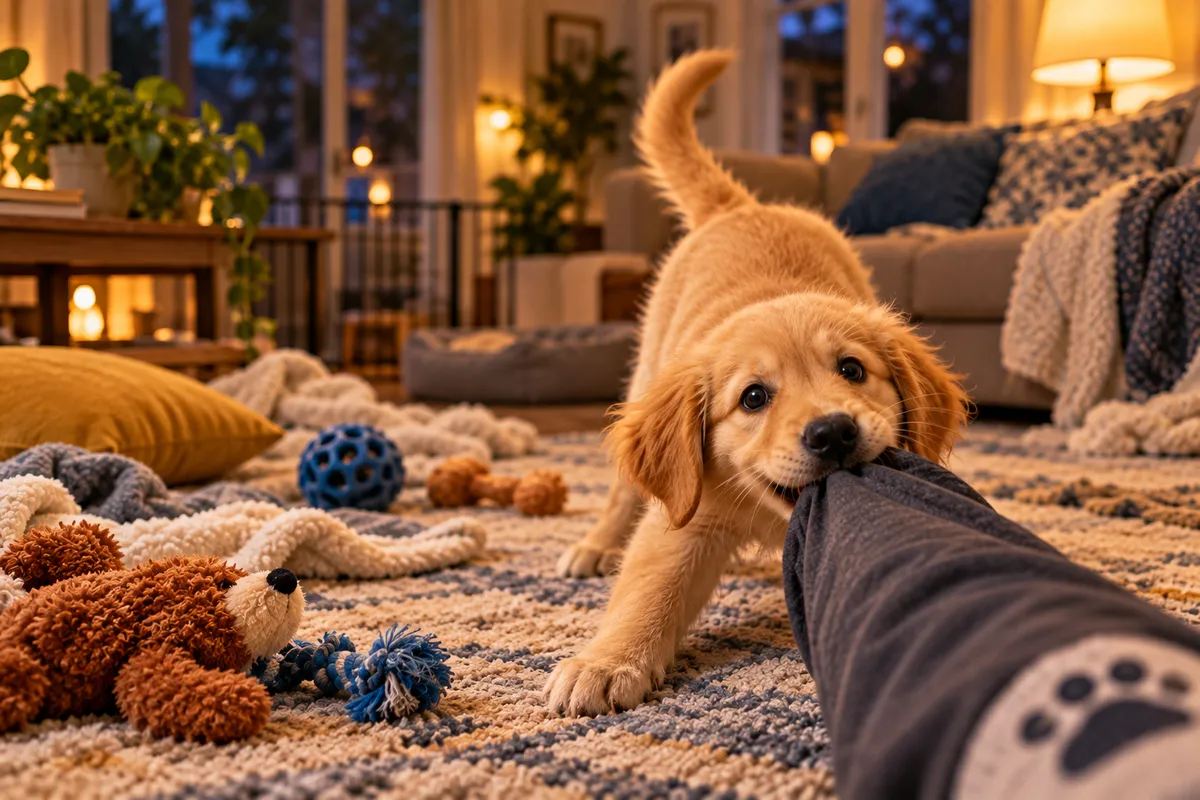
Suddenly, there is a tiny, furry piranha attached to your pant leg. They are biting your hands, stealing couch pillows, racing through the living room, and ignoring requests to “sit” as though they have never heard a human voice before.
You may wonder whether your puppy needs more exercise—or whether you have accidentally adopted a small, furry menace.
Before planning another long walk, consider a less obvious possibility: Your puppy may need help slowing down.
Let's Talk About The “Witching Hour”
People often call this predictable burst of evening activity the puppy “witching hour.” It may include zooming, mouthing, barking, grabbing clothing, stealing objects, or struggling to settle.
This does not automatically mean your puppy is aggressive, defiant, or trying to dominate you.
Your puppy may need a bathroom break. They may be hungry, teething, frustrated, overstimulated, understimulated, or looking for interaction. The household may become busier in the evening, or your puppy may have spent the day without enough comfortable, uninterrupted rest. Being overtired is also another pretty common contributor.
Ask yourself: When does the behavior begin? What happened beforehand? How much did my puppy truly rest today? Can they engage with a chew or food toy? Does the behavior improve after a bathroom break, a quieter activity, or sleep?
Puppies Need More Than Physical Exercise
When a puppy becomes wild, our first instinct is often to increase their activity to tire them out.
Sometimes movement or play is appropriate. But more activity is not always the answer. An overwhelmed puppy may become increasingly mouthy and frantic when we add vigorous exercise, exciting games, or another training session.
Research on young dogs found that 16-week-old puppies slept more during the day and over a full 24-hour period than 12-month-old dogs. The authors also emphasized that canine sleep is still understudied and that individual sleep needs and patterns vary. (Source: Sleep Duration and Behaviours in Dogs up to 12 Months of Age)
In other words, there is no single nap schedule that proves you are doing puppyhood correctly.
Instead, notice whether your puppy has opportunities to rest—and whether the environment allows them to use those opportunities uninterrupted.
Make the Evening Easier Before They Become a Land-shark.
If your puppy predictably becomes bitey at 8:00 p.m., begin changing the setup before then.
You might:
Offer a bathroom break before the usual chaos begins
Lower household activity and reduce exciting play
Set them up with an appropriate chew, food toy, or licking activity
Use a gate or pen to promote relaxation and prevent repeated access to ankles and clothing
Sit nearby while your puppy settles in a comfortable resting area
Move tempting pillows, shoes, and loose clothing out of reach
Schedule a calm sniffing or foraging opportunity earlier in the evening
A resting area does not always have to be a crate, although crates are wonderful tools for puppies when used correctly and not as a method of punishment. Use a setup where your puppy can comfortably relax. If confinement causes panic, persistent vocalizing, frantic escape attempts, or escalating distress, closing them in and waiting them out is unlikely to create restful sleep or settling.
Using resting areas are a method of management.
Management is not a punishment. It keeps everyone from rehearsing the same exhausting sequence: puppy bites, person yelps, puppy gets more excited, person waves their arms, puppy decides the evening has become an excellent party.
Teach Without Turning It Into a Battle
Keep a toy nearby and calmly redirect your puppy toward something appropriate to bite or carry. If they continue targeting your body or clothing, step behind a barrier (like a gate) briefly or help them transition to a quieter activity (like a pen or crate).
Avoid holding their muzzle closed, yelling, pinning them down, or using physical corrections. AVSAB recommends reward-based training and environmental management rather than aversive methods for unwanted behavior. (Source: AVSAB Humane Dog Training Position Statement)
Your puppy is not giving you a hard time. They may be having a hard time regulating what their very young body is doing.
When Evening Biting Needs a Closer Look
Talk with your veterinarian if the behavior changes suddenly, appears connected to touch or movement, prevents your puppy from resting, causes concern about pain, or is accompanied by changes in appetite, digestion, sleep, or general behavior.
Personalized training support is also appropriate when biting is causing injuries, interactions feel unsafe, confinement creates distress, or you cannot identify what your puppy needs.
If your evenings have become something you brace yourself for, you can schedule a free discovery call with Born to Be Dog Training. I can help you look at the entire pattern—not blame you or your puppy for the hardest hour of the day.
Your puppy may still become a tiny evening shark sometimes.
But once we understand what is feeding the pattern, we can stop throwing more excitement at an exhausted nervous system—and start giving your puppy the kind of support they can actually use.
This article provides general educational information and is not a substitute for veterinary diagnosis, treatment, or an individualized behavior assessment. Contact your veterinarian about sudden behavior changes, suspected pain, disrupted sleep, injuries, or other health concerns.
Sources and Further Reading
American Animal Hospital Association — How Sleep Shapes Canine Behavior — July 17, 2026 overview of sleep and behavior, including evening puppy biting.
Sleep Duration and Behaviours: A Descriptive Analysis of a Cohort of Dogs up to 12 Months of Age — observational research comparing owner-reported sleep patterns at 16 weeks and 12 months.
American Veterinary Society of Animal Behavior — Humane Dog Training Position Statement — professional recommendations supporting reward-based training and humane management.