My Dog Hates Nail Trims. What Should I Practice First?
By: Leah Bornstein (CDBC, CSAT, FFCP, VSA-CDT)
You bring out the nail clippers.
Your dog spots them from across the room and immediately disappears behind the couch.
Maybe they pull their paw away. Maybe they freeze. Maybe they growl when you reach for them. Eventually, two people are involved, everyone is sweating, and somehow only one nail has been haphazardly trimmed.
If this sounds familiar, your first training goal probably should not be “finish all four paws.” It should be helping your dog feel safe enough to participate.
Nail Trims Aren’t Only About the Clippers
When a dog struggles with nail trims, it’s tempting to blame the tool.
But your dog may be responding to several pieces of the process: having a paw lifted, pressure on a toe, the sound of the clipper, vibration from a grinder, slippery flooring, being restrained, or even remembering a painful experience.
Physical discomfort matters too. A dog who suddenly becomes sensitive about having a leg or paw handled may be experiencing pain, an injury, skin irritation, or in some cases, another medical concern.
Before building a training plan, ask: Which part is difficult for my dog?
“Doesn’t like nail trims” is a starting point—not the whole answer.
Cooperative Care Changes the Conversation
Cooperative care means teaching an animal to participate voluntarily in grooming, handling, or veterinary procedures.
That does not mean your dog understands nail anatomy and signs a consent form. It means we create clear ways for the dog to say, “I’m ready,” “I need a pause,” or “That step is too difficult.” And most importantly - the human honors those boundaries your dog sets.
If your dog says "I need a minute", you give them a minute!
The American Animal Hospital Association describes cooperative care as a positive reinforcement-based approach that can include targeting and stationing behaviors for procedures such as nail trims, injections, and blood draws. (AAHA)
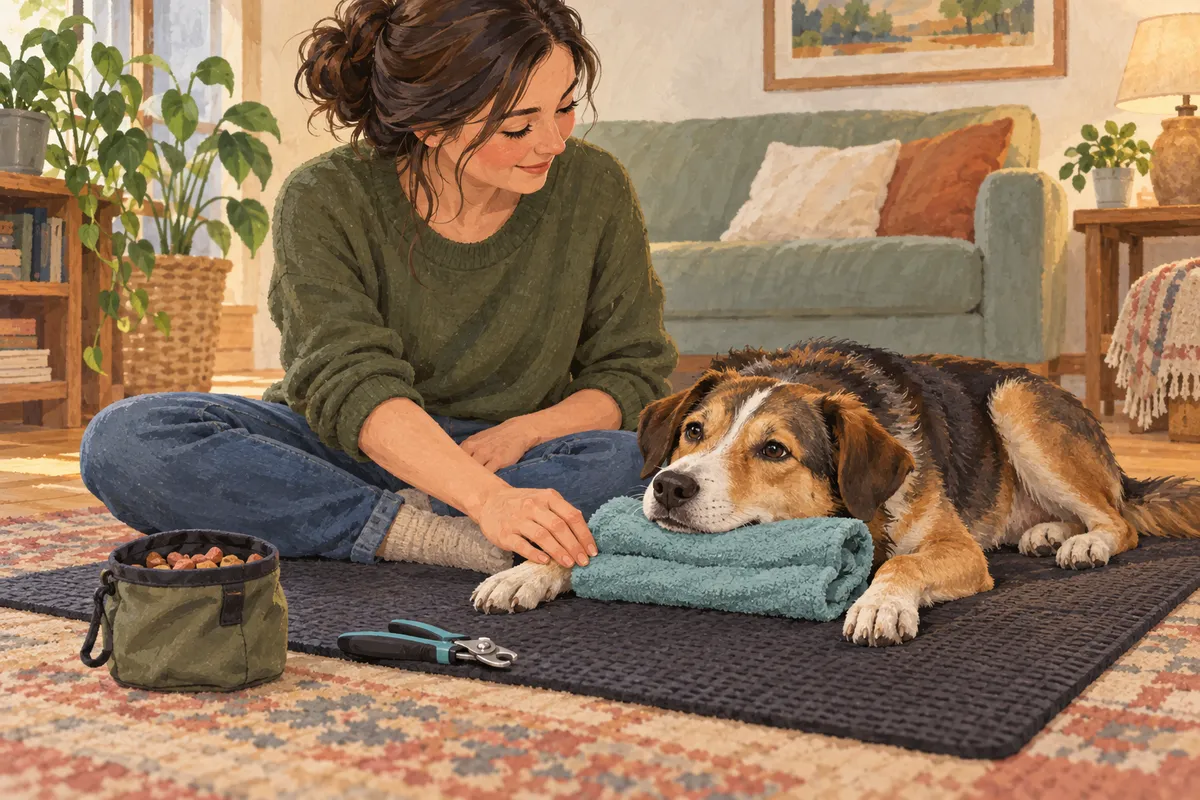
A chin rest is one example. Your dog rests their chin on your hand or a towel to begin. You briefly touch their shoulder, then stop and reinforce them. If they lift their head, your hands pause. The head coming off the towel is a clear request for space. Head down on the towel indicates consent to proceed.
Your pup's movement communicates something useful - are you listening?
Start Where Your Dog Can Succeed
If your dog leaves when you touch their paw, beginning with “hold the paw longer” is probably too difficult.
You might begin with:
Reaching for the paw without even touching it
Your hand moving toward their shoulder
One second of contact on the shoulder
Your hand sliding slightly down the leg
A brief touch near the paw
The correct starting point depends on the dog in front of you. The goal is to find a version where they can remain comfortable, eat if treats are being used, and freely move away.
You are not testing how much they will tolerate. You are building predictability and consent.
A Pause Is Information
Watch for more than growling or snapping.
Turning away, leaning back, tucking a paw underneath the body, repeatedly licking lips, becoming very still, refusing food, or leaving can all tell you the current step may be too difficult. Waiting until they're growling or snapping can mean you missed some of those earlier stress signals.
However, none of these signals proves one specific emotion, so consider the entire context.
Research and veterinary guidance support minimizing fear and stress during handling. More restrictive handling has been associated with stronger fear-related responses, while low-stress handling is recommended for both patient welfare and human safety. (PMC)
Pausing when your dog struggles does not “reward bad behavior.” It helps prevent the procedure from becoming an even bigger battle next time.
What If the Nails Need to Be Trimmed Now?
Training and urgent care are different problems.
If your dog’s nails are affecting movement, breaking, curling toward the paw pad, or creating another health concern, contact your veterinarian. Ask about the safest immediate plan, which may include medication or sedation prescribed and supervised by the veterinary team.
Medication is not a training failure. Sometimes it is the kindest bridge between what your dog needs medically and what they can currently handle emotionally.
A scratchboard may help maintain some front nails, but it is not appropriate for every nail or every dog.
If nail care has become stressful or unsafe, I can help you break the process into steps that fit your dog. You can schedule a free discovery call with Born to Be Dog Training to discuss individualized cooperative-care support.
The first win may not be a shorter nail. It may be your dog learning that when they ask for a pause, someone listens.
This article provides general educational information and is not a substitute for veterinary diagnosis, treatment, or an individualized behavior assessment. Consult your veterinarian about pain, sudden handling sensitivity, overgrown or damaged nails, medication, and sedation.
Sources and Further Reading
American Animal Hospital Association — Less Stress and Better Outcomes With Cooperative Care
Handling Techniques and Risk Factors Reported by Veterinary Professionals During Dog Examinations
Effects of Changing Veterinary Handling Techniques on Canine Behaviour and Physiology
The Pet-Friendly Veterinary Practice: A Guide for Practitioners