Resource Guarding
By: Leah Bornstein (CDBC, CSAT, FFCP, VSA-CDT)
Your dog trots into the room carrying a stolen sock.
You reach for it. They freeze, lower their head, or give you a growl that makes the message pretty clear: This sock is mine now.
Suddenly, laundry has become a hostage negotiation.
If your dog growls over something they picked up, the first goal is not proving that you can take it. The first goal is keeping everyone safe and preventing the situation from becoming more confrontational.
Understanding Resource Guarding
Resource guarding refers to behavior a dog uses to maintain access to something they value. That might be food, a chew, a resting place, a person, or one extremely important sock.
Resource guarding is generally rooted in fear or concern about losing access—not dominance or a desire to control you. Pain, stress, hunger, competition with another animal, previous experiences, and the value of the resource can all affect how strongly a dog responds.
Humans guard resources too. Maybe you have a favorite coffee cup that nobody else is allowed to use. Maybe you’re very particular about who touches—or drives—your car. We understand the feeling of, “This matters to me, and I don’t want you taking it.”
Protecting access to something valuable isn’t a power play. It often comes from concern about losing something important.
But My Dog Is Growling at Me—Isn’t That Dangerous?
It can be—especially if we ignore it!
A growl is useful information. I never punish a dog for growling. I thank them for telling us they are uncomfortable before they feel the need to communicate more forcefully.
Punishing a growl may stop the sound, but it does not necessarily change how the dog feels. If we remove that warning without addressing the discomfort underneath it, we may be left with fewer warning signs before the dog escalates. The dog learns: "Growling doesn’t make them listen or give me space, so I need to defend my resource more forcefully.”
Think of a growl like one of those yellow “Wet Floor” signs. We don’t get angry at the sign for warning us that the floor is slippery. We appreciate the warning because it gives us a chance to slow down, change course, and avoid getting hurt.
What to Do in the Moment
Pause. Do not reach for the object, grab your dog’s collar, scold them, corner them, or try to pry their mouth open. Please don’t. Fight the urge!
Do create distance and keep other people and animals away. Find something extremely high-value that your dog can safely eat. Maybe they go cuckoo for hot dogs. Maybe they love cheese or deli meat.
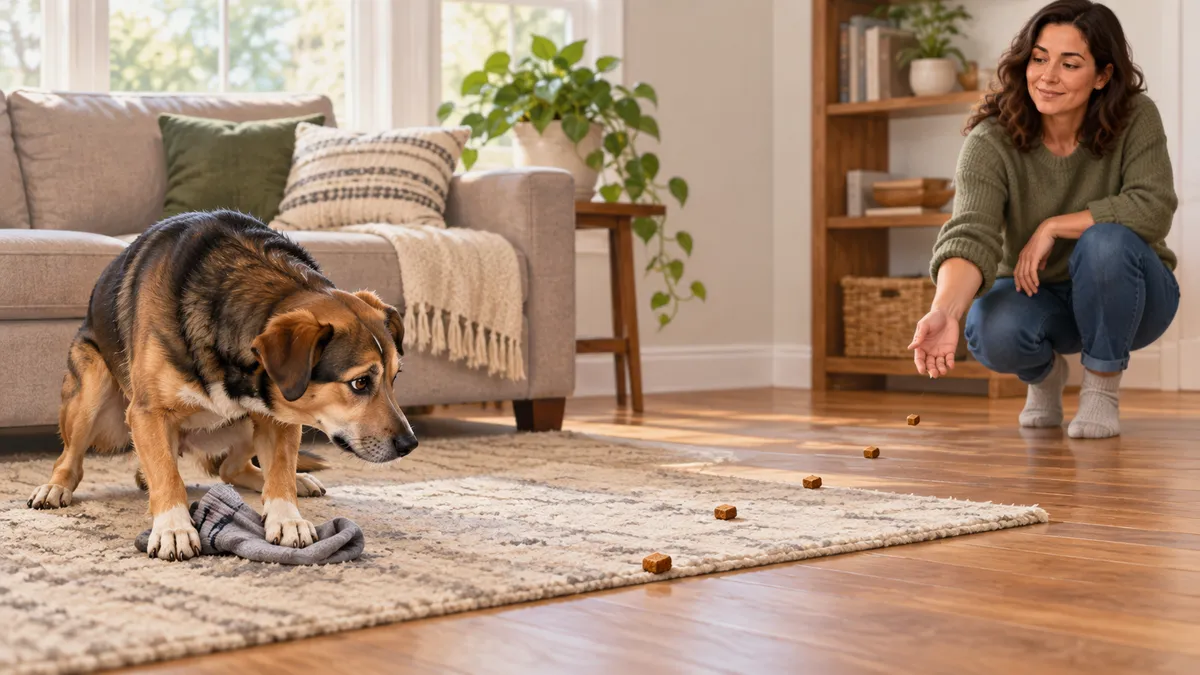
Start by tossing one treat close enough that your dog can eat it without leaving the resource. They probably won’t walk away from their treasure immediately—and that’s okay. First, we need to know whether they can eat and whether your presence at that distance feels safe enough.
If your dog takes the first treat, toss another one slightly farther away. Continue slowly, creating a trail that leads them away from the resource. Do not rush this or use the food to lure them closer to you. We want the dog moving away from the item voluntarily.
Once your dog has moved a safe distance from the resource, this is the most important part: DO NOT rush towards the resource. Instead, guide them into the backyard, behind a closed door, or behind a secure gate. Make sure they are safely separated and ideally out of sight before you return to retrieve the item.
Avoid trading one guarded resource for another guarded resource. A bully stick may be highly valuable, but if your dog is likely to guard that too, you may exchange one difficult situation for another. I would only consider that during a genuine emergency when the original item presents a more immediate danger.
The treat toss is not a test. If your dog will not eat, move away, or follow the trail, do not keep approaching or push the issue. Their response tells you the situation is still too difficult.
If the object is dangerous—such as medication, a sharp item, or something toxic—contact your veterinarian or an emergency veterinary service for immediate guidance. The medical risk may change what needs to happen, but reaching into a guarding dog’s mouth can create an additional emergency to the human.
Why “Taking It to Show Them” Can Backfire
It can be tempting to think, They need to learn that I’m allowed to take things.
But repeatedly removing items by force can teach your dog that your approach predicts loss or conflict. The next time, they may swallow faster, run farther, guard sooner, or skip the growl and move to a more serious response.
As you can see, this will only amplify the resource guarding issue.
Pausing and giving them space doesn't mean the dog “won.” It means you chose safety over turning a sock into a showdown.
Management matters here. Keep laundry, trash, children’s toys, and other commonly stolen objects out of reach when possible. If multiple dogs are involved, separate them around food, chews, stolen items, and other resources that have caused tension.
Build the Skill Before You Need It
Practice trades when nobody is upset and the item is not something your dog guards.
Offer something better, allow your dog to move away from the original object, and return the original item when it is safe and appropriate. Returning it sometimes helps teach that giving something up does not always mean losing it forever.
The goal is not to rehearse taking prized objects. It is to build a history in which your presence predicts safety and good things—not competition to their resource.
Avoid practicing with items your dog already guards without individualized guidance. Resource guarding plans need to account for the dog, the household, the objects involved, and the level of bite risk.
When to Bring In Help
Seek professional support if guarding is frequent, escalating, directed toward children or other animals, or has involved snapping or biting. Sudden guarding or a significant change in behavior also deserves a veterinary conversation because pain and other medical concerns can affect tolerance and behavior.
If resource guarding has you feeling nervous or unsure about what is safe, you do not have to figure it out on your own. Use barriers and prevent access to commonly guarded items while you get support. This is something I can help you with.
You can schedule a free discovery call with Born to Be Dog Training, and we can talk about what you’re seeing, the safety concerns in your home, and whether individualized behavior support would be helpful.
This article provides general educational information and is not a substitute for veterinary diagnosis, treatment, emergency guidance, or an individualized behavior assessment. If there is a bite risk, a child in the home, or a dangerous object involved, prioritize separation and professional support.