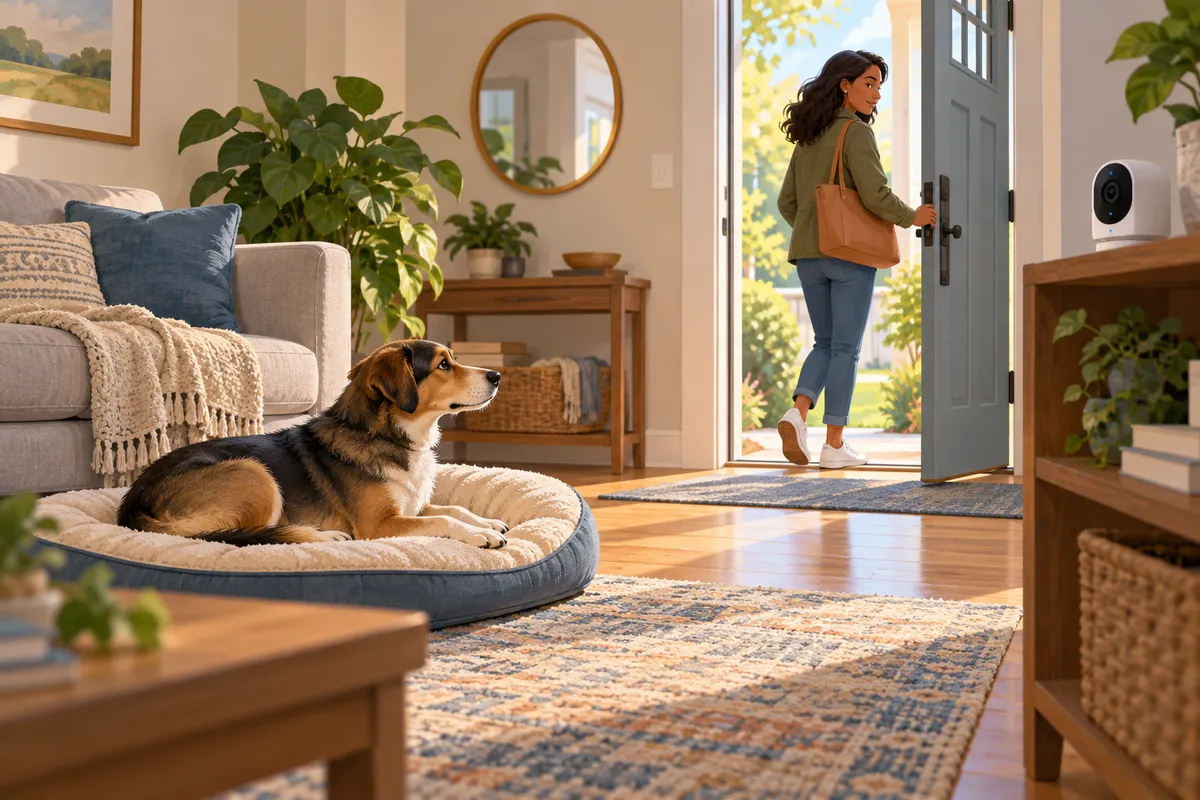
Does My Dog Have Separation Anxiety—or Do They Just Like Following Me?
By: Leah Bornstein (CDBC, CSAT, FFCP, VSA-CDT)
You stand up to refill your water. Your dog stands up too.
You walk to the bathroom. They follow.
You're doing dishes, and you turn around to nearly trip over the furry assistant, who apparently supervises all household operations.
At some point, you start wondering: Does my dog have separation anxiety? Maybe. But following you around the house does not answer that question.
Separation anxiety is about what happens when alone time occurs—not how enthusiastically your dog accompanies you to the kitchen.
Following You Is Not a Diagnosis
Dogs follow people for many reasons.
You may be the person who provides meals, walks, play, access to the yard, and the occasional piece of cheese. Your dog may enjoy your company, be curious about what you are doing, or have learned that following you leads somewhere interesting.
Some dogs also seek more proximity when they feel uncertain, uncomfortable, or unwell. If the following is sudden or comes with changes in appetite, sleep, movement, bathroom habits, or behavior, consider talking with your veterinarian to rule out anything medical.
Close following can occur in dogs with separation anxiety, but it also occurs in dogs who relax comfortably once their person leaves. The Merck Veterinary Manual notes that dogs who follow family members around the house are not necessarily at greater risk of separation anxiety. Merck Veterinary Manual
The important question is not, “Does my dog follow me?”
It is, “What does my dog do when I am gone?”
Let the Camera Answer
Set up a phone, tablet, laptop, or home camera where your dog usually spends time. Proceed with an ordinary departure rather than creating an elaborate test.
Keep an eye on the recording while you step out. If your dog begins panicking, go right back inside. We do not need to leave them in distress to prove that they are struggling.
If your dog is not immediately panicking, notice what they do. Do they settle after a few minutes? Pace between rooms? Remain near the door? Bark briefly and then lie down? Stay restless? Make note of whether they settle at all—and how long it takes.
Video is useful because barking, destruction, and accidents can have several possible explanations, including outside noises, confinement distress, incomplete housetraining, boredom, or separation-related fear. AVSAB
Do not look only for a demolished door. Watch for:
Pacing or repeatedly checking exits
Panting or drooling without an obvious temperature-related reason
Whining, barking, or howling
Freezing or remaining unusually still
Scratching or biting at doors, crates, or windows
Refusing food or interactive feeders they would ordinarily eat
Being unable to settle or sleep
Urinating or defecating
Distress that intensifies as the absence continues
Also notice what happens before you leave. Does your dog become restless when you put on your shoes, pick up your keys, or begin your usual departure routine?
One behavior does not provide the whole answer. Look at the sequence, intensity, duration, and recovery. A dog who barks twice and then naps is showing us something very different from a dog whose distress continues or escalates throughout the absence.
If you are unsure what you are seeing, professional eyes can help. A Certified Separation Anxiety Trainer (CSAT) can join for an assessment, help you understand the pattern, and determine what support may be appropriate.
If You See Distress, Don’t Test Their Limit
If your dog panics during an absence, avoid leaving them longer to see whether they will “get used to it.” Repeated exposure at full intensity can worsen fear rather than teach comfort.
Separation distress is the equivalent of a full blown panic attack. Imagine being trapped in an elevator while your heart races, your breathing becomes shallow, and every part of your body is screaming that you need to escape. You’re not being dramatic—your nervous system believes you’re in danger. Staying trapped in that elevator does not help you “get used to it.” In fact, it may make elevators feel even more frightening. The next time those doors open, you may hesitate, avoid getting in, or take the stairs if you can.
Separation distress works similarly. Leaving a panicking dog alone for longer does not teach them that being alone is safe. It may teach them that the fear they feel when you leave is something they really do need to worry about.
Management is an important part of supporting dogs experiencing alone-time distress. This may mean arranging help from family, a sitter, daycare when appropriate, or another safe care option so your dog is not repeatedly left to panic while you work through an individualized plan.
A Certified Separation Anxiety Trainer (CSAT) can help you understand what you’re seeing, determine your dog’s current comfort level, and guide the training process. Veterinary involvement may also be appropriate—particularly if the behavior appeared suddenly, is severe, involves self-injury, or could be affected by pain or another medical condition. Physical conditions can resemble, contribute to, or complicate separation-related problems. (PubMed)
For some dogs, medication may be an appropriate and humane part of treatment. A CSAT can help you recognize when a veterinary conversation may be useful, while all decisions about prescribing and managing medication belong with your veterinarian.
If the camera shows that your dog is struggling when left alone, I can help you understand what you are seeing and create a plan that works below your dog’s panic threshold. Schedule a free discovery call with Born to Be Dog Training.
Your dog following you into the bathroom may be companionship, curiosity, habit—or concern that you will find snacks without them.
The camera helps us learn what happens when they cannot follow.
This article provides general educational information and is not a substitute for veterinary diagnosis, treatment, or an individualized behavior assessment.
Sources and Further Reading
American Animal Hospital Association — Separation Anxiety in Pets: Signs, Causes, and Solutions
American Veterinary Society of Animal Behavior — How to Tell if Your Dog Has Separation Anxiety
Developing Diagnostic Frameworks for Separation-Related Problems in Dogs
Separation-Related Problems and Their Interaction With Physical Disease